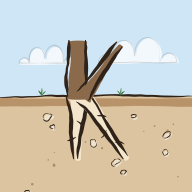
I was itching for a new daily puzzle game to play with my close ones, and thought to myself, why not make one? And so I did!
That was the evening of 15 October 2026. I had an empty template repo and a name I was very pleased with: latKis. This post is the notebook version of what happened next, from the first evening to the point where the puzzle stopped being a puzzle about words and started being a puzzle about a tree.
The first evening
latKis was a pun on lattice, because each tile linked to two tiles in the next column. It also sounded like latkes, and it hid a capital “Ki”. I was loving the pun, but I realised that it is not roll-off-the-tongue friendly, and I wanted something more recognisable. That came later, though.
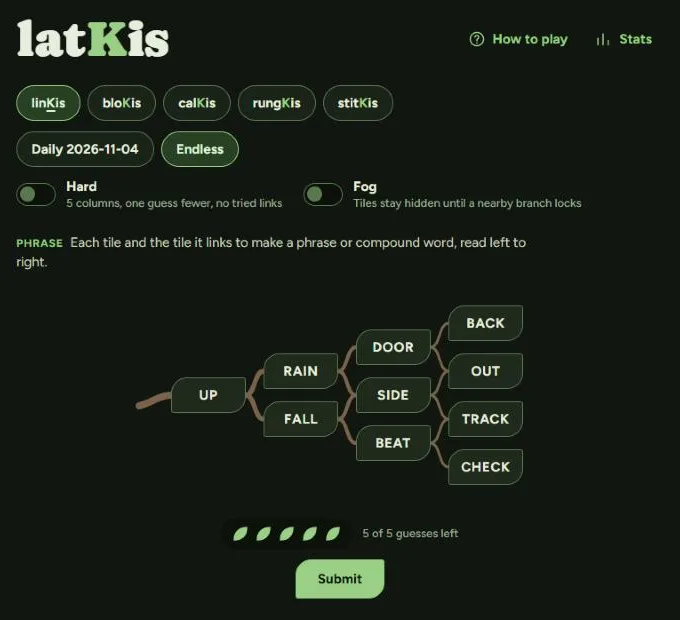
The rules came first. You drag tiles to swap them around the board, then you submit, and every correct link turns green and locks in place. If you run out of guesses before every link is green, the board ends. A link counts only when it matches the answer, not when it happens to be a valid link, so the generator throws a puzzle away unless exactly one arrangement solves it.
I also wanted the whole thing to cost nothing to run, or close to nothing. So there is no game server. The daily puzzles are plain files, and the endless ones generate inside your own browser. Your phone does the work my server would have done. (Accounts came four days later, on 19 October.)
The board itself was a sideways lattice: one tile on the left, then two, then three, then four. Neighbouring tiles shared a child, so SIDE hangs off both RAIN and FALL. Hard added a fifth column.
Three rules
Link puzzles have three classic rules, and I started with all three:
| Rule | A link is right when | Example |
|---|---|---|
| Phrase | The two words make a phrase | SNAIL > MAIL |
| Word | The two fragments join into one word | WAL > RUS |
| Math | A tile’s number comes from its two children and an operator | 15 > 3, ×, 5 |
Phrase and Word sound close, and on day two I had to draw a line between them. Phrase takes phrases only, with no compound words. SNAIL MAIL is two words, so it is a phrase. WALRUS is one word, so it belongs to Word.
Math had its own limits from the start: whole numbers only, division only when it comes out exact, and nothing above 999. Nobody wants to split 17 into thirds on a phone at 7am.
Two new rules
I wanted more challenges than the three classic rules, so I wrote down every other link rule I could think of, and these made the shortlist:
- Ladder: the two words differ by one letter. WOLF > GOLF.
- Splice: the end of one word starts the next. PICNIC > NICKEL > KELP.
- Drift: each word is a near synonym of the last. HOT > WARM > MILD > COOL > COLD.
I picked Ladder and Splice. My test was whether a player can check a link in their head and be sure. A ladder link and a splice are both either right or wrong, with nothing to argue about. Drift fails, because whether MILD is “near” WARM is an opinion, and an opinion makes a terrible answer key. It sits on the shelf for now. Shall see if it comes back one day~
Splice changed once I played it a few times. It was hard to read at a glance, so on day two the board started to highlight the last three letters of each word. Today a splice needs at least three shared letters.
The names
I like a naming scheme, and every mode got a hidden capital K. It took three tries:
| Rule | 15 Oct | 16 Oct | 19 Oct onwards |
|---|---|---|---|
| Phrase | linKis | linKage | Kompanion |
| Word | bloKis | conKat | catKin |
| Math | calKis | calKilate | Kalyx |
| Ladder | rungKis | sKip | Klimber |
| Splice | stitKis | Kross | sKion |
The first two rounds named what each mode does. The third round named what the game was turning into, which was a plant. Kompanion is companion planting. A catkin is a cluster of tiny flowers. A calyx holds a flower, and it sounds like “calc”. A climber grows up a trellis. A scion is the cutting you splice onto a tree in a graft.
From lattice to tree
On that first evening I also had to pick a look. The first three directions were a cast-iron griddle (for the latkes), a garden trellis (for the lattice) and a newspaper puzzle page. None of them felt right. My note back was “i want a more tree like nature look especially”. The next round had a direction called Canopy, with leaf-cut cards and bark branches, and I took it.
A simple endeavour into choosing colours turned out to be more than just that, it led into the overhaul of the game.
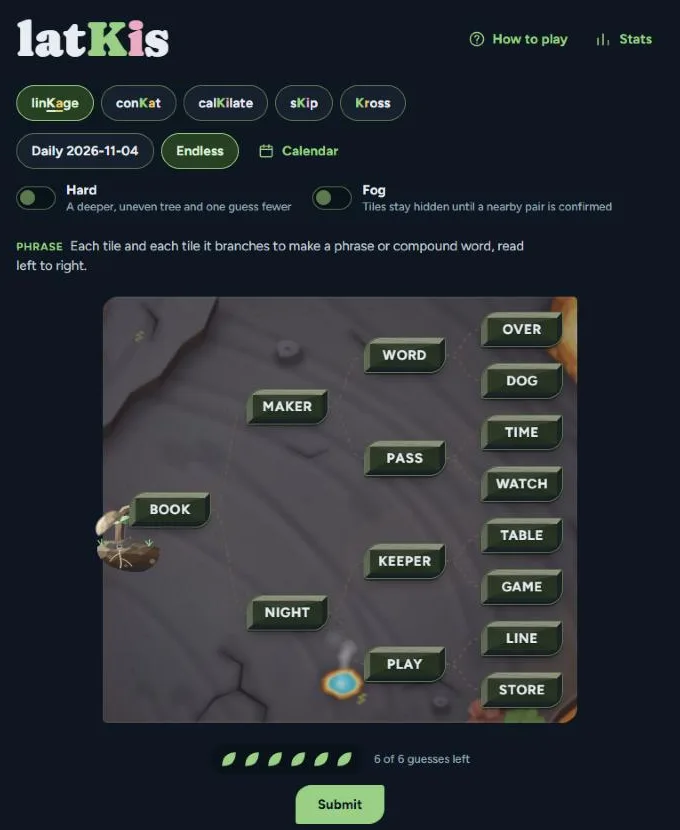
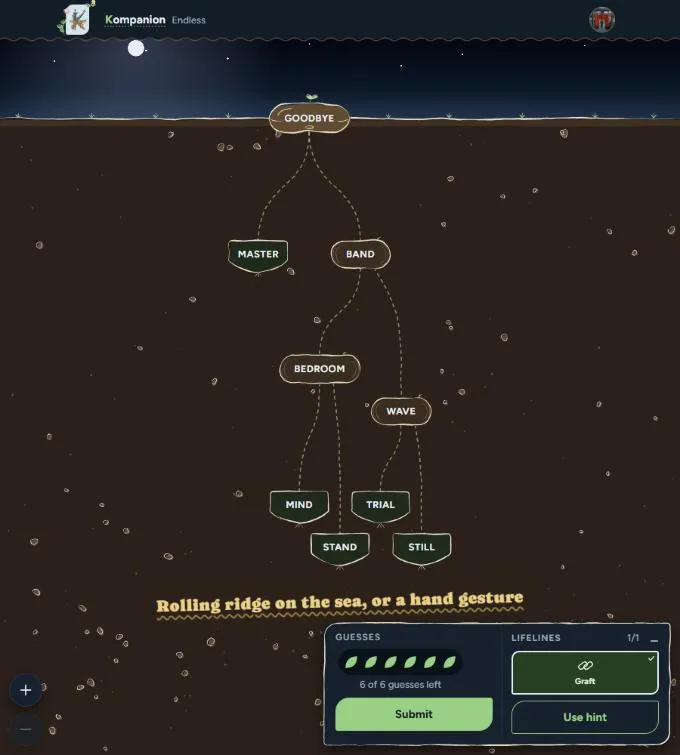
On the evening of 16 October I rebuilt the board as a tree of joined tiles, where no two branches meet, so the shared children of the lattice were gone. That version went live just after midnight on 17 October (#2), with all five modes, a Hard setting and a Fog setting. On 18 October every tile got two or three children instead of always two. On 19 October came the daily plant (#39): roots that grow down from a shared seed word, and a crown that grows up from it once the roots are done.
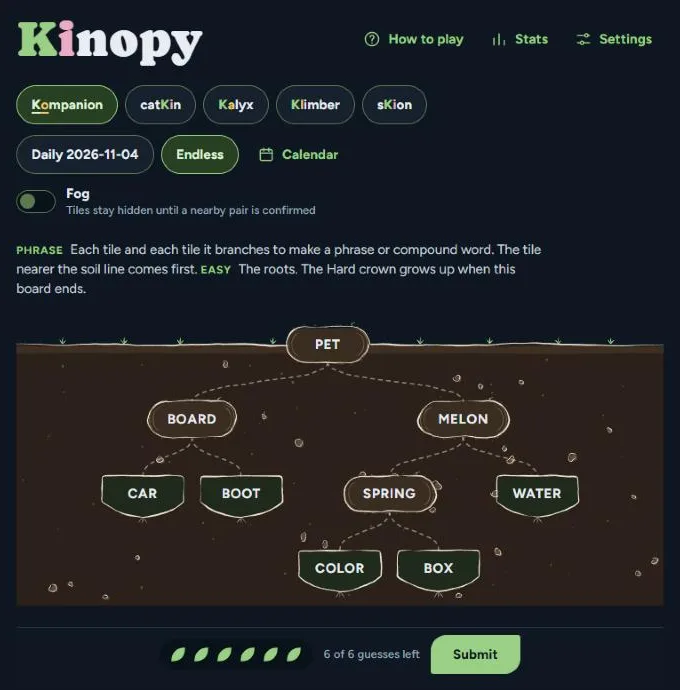
While I planned the daily plant, it hit me that latKis was turning into a plant game with a pancake name. So I went looking for tree words, and the daily plant shipped under the new name: Kinopy, from canopy, with a “Ki” and a “Kin” hiding inside. It rolls off the tongue a lot better.
Looking back
I set out to make a word puzzle for my close ones. Four days later it was a plant game, and the word puzzle was still in there, holding the branches together.
The next post is about the art: why the plants have no image files at all, and how the game’s code draws every ink line.
Give it a go and tell me which tree you got!