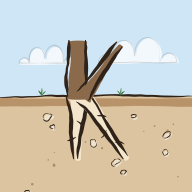
Kinopy has no image files for its plants. Every line you see on a board, from the seed on the soil line to the last leaf on the crown, is drawn by the game’s own code each time the plant grows!
That was not the plan on day one. latKis v1 went live just after midnight on 17 October with a low-poly look I called Sulfur Springs, and by that same morning it was gone again. This post is about the look that replaced it: ink and wash, a pen line that swells and thins, with flat watercolour that misses the line a little.
Sulfur Springs
Sulfur Springs is named after a map in a game I love, and I was loving its visual aspect. I tried to bring that look into latKis with low-poly pieces, but I failed to capture what made me love it in the first place. So on the morning of 17 October I set it aside and went back to the older visuals (#3). The low-poly art still sits on its own branch.
Three looks
Two days later the daily plant was on its way, with roots that grow down under a soil line and a crown that grows up above it. I wanted its look to be simple and hand-drawn, so I put three looks side by side on a style board and picked ink and wash. It came in with the daily plant on 19 October (#39), and it runs on a handful of rules.
The pen line
Every drawn thing has one pen line. In SVG, the easy way to draw a line is a stroke, and a stroke keeps the same width from end to end. A real pen does not do that, so the pen line in Kinopy is a filled ribbon instead: the code walks along the line, picks a width at each point, and draws the outline of the shape that makes.
The width follows a seeded pressure curve between 0.5 and 1.35 times the nominal width, and the ribbon tapers over the first and last 16% of its length, so every line starts and ends on a point. A closed outline, such as a tile, draws as two strokes that overlap a little where they meet, as a pen does when you lift it and start again. Each stroke starts at a seeded point on the loop, so no two tiles have their join in the same place.
Each kind of thing gets its own nominal width:
| Thing | Nominal width |
|---|---|
| Tile outline | 1.5px |
| Tuber and cone outline | 1.4px |
| Limb and root edges | 1.2px to 1.5px |
| Small marks: eyes, rings, needles, root hairs | 0.75px to 1.05px |
The wash
The colour is a flat wash with no gradient. It sits 1.3px right and 1.1px down from its line, so the paint misses the line a little. A second, smaller copy of the shape pools in the lower right corner at 7% of the pen colour. Limbs, roots and tiles skip the pool.
The crops show it best. Flowers do not grow on roots, so on the Easy board a solved root link grows a tuber instead, and there are seven crops in the patch: potato, carrot, radish, beet, onion, garlic and ginger. Each solved link picks one by seed, and two sibling links never grow the same crop. A tuber’s size follows the width of its root, so the biggest ones sit near the soil line and the smallest ones at the tips.
On 21 October the tubers took the look of the new logo (#172). A round tuber now hangs from a short tapered rootlet that leaves the side of its root, a carrot joins by its leafy top, and a leaf on the crown joins its limb on a short stalk.
Seeds, not filters
SVG has filters that can roughen a line, but I kept to our own code: a seeded wobble, with no SVG filter and no new package. A piece of art takes one seed, such as the puzzle id and a link index, and every random choice comes from it, from the wobble and the pen pressure to where a stroke starts. So the same plant draws the same way on every device, every time you open it.
The words never wobble. They stay crisp in Figtree, and a drag checks the clean tile rectangle, not the wobbly outline, so the hand-drawn look never gets in the way of a drop.
The boil
Hand-drawn animation has a trick called line boil: you draw the same thing a few times, and when the drawings play in a loop the lines shimmer. Kinopy keeps three drawings of every piece and swaps between them while the plant grows.
The first boil gave each drawing its own random wobble and swapped them 8 times a second, which read as a shake. On 20 October I changed it to an even sway (#76). Now all three drawings share every random choice, so a line keeps its shape, its pressure and its stroke start. The only difference is that the wobble slides a little along the line, one way in the second drawing and the other way in the third. The boil plays them in the order rest, one way, rest, the other way, at 170 ms a drawing.
The boil only runs while something grows, such as when a link locks and its tuber appears. At rest, every piece shows its first drawing. The clock skips its ticks while the page is out of view, and if your device asks for reduced motion there is no boil at all.
Light and dark
In the dark theme the pen turns to a warm pale colour, like white gel pen on black paper. The link states never rely on colour alone, so the hand-drawn look keeps them apart by shape too. An open link is a faint dashed guide, a tried and wrong link is a rust dotted line with an x in a ring, and a locked link is a filled root below the soil line or a filled limb above it.
Drawing it fast
Drawing all of this in code has a cost. When you won a Hard board, the game drew the final tree in one long frame, then drew its two other boil drawings in two more ticks of about 360 ms each. On 20 October the final tree moved to a worker. When the last Hard pass starts, the plant asks an art worker for all three drawings, and the pass runs for about two seconds, which gives the worker time to finish. If the input changed in the meantime, the plant draws the tree on the main thread as before.
Looking back
A look that I loved but could not capture led to a look that is drawn fresh every time, and the code that draws a potato on a root is the same code that draws the rest of the plant.
Ink and wash was not the last change, though. The visuals went through a few more rounds after this, with the tree genome and the v5 trees, and I will go through those in a future post.
Give it a go and tell me which crops your roots grew!